

Blooms is a puzzle about placing flowers. Every row, every column and every coloured region gets exactly one, and no two flowers may touch, not even at the corners.
The rules
The board is split into coloured regions. When it’s finished, each row, each column and each region holds exactly one flower. Flowers can’t sit next to each other in any direction, diagonals included. Two flowers on the same diagonal are fine as long as they aren’t neighbours.
You can also mark cells where a flower can’t go. Marks are notes for you; the game doesn’t need them to count the board as finished. They make it much easier to work by elimination.
Every flower clears space
Each flower rules out a lot of the board: the rest of its row, the rest of its column, the rest of its region, and the eight cells around it. Mark them all. The diagonal neighbours are the ones people forget, because they sit in a different row and column. Sometimes the touching rule is the only thing that rules a cell out.
Then look for a row, column or region with only one unmarked cell left. Its flower has to go there. Place it, mark what it rules out, and look again. One flower often settles a second or third this way.
Worked example
A diagonal neighbour can settle another region
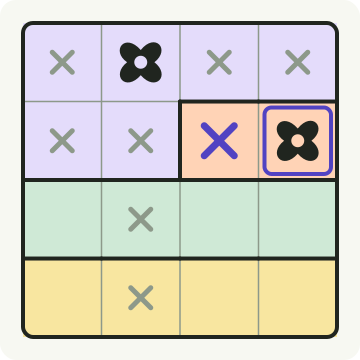
- The flower in row 1, column 2 is already placed. Grey crosses mark the rest of its row, its column and its lilac region.
- The apricot region has just two cells, in row 2, columns 3 and 4. Column 3 is in a different row, column and region from the flower, but it touches the flower diagonally, so it can’t hold one.
- That leaves row 2, column 4, so the apricot region’s flower goes there.
A teaching board, not one of today’s puzzles.
Pairs that lock a region
Say a row has just two cells left that could hold its flower. You don’t know which one yet, but if both cells belong to the same region, that region’s flower must be in this row. Every other cell of that region can be marked. It works the other way round too: if all of a region’s remaining cells sit in one row, the rest of that row must be empty. The same goes for columns.
Before you call it done
A board can have one flower in every row and column and still be wrong. A region might be empty, or two flowers might touch at a corner. Check all four rules. If you’re stuck, a hint will point to a flower to place or one to rethink.