

Paths is a single line through the whole board. Start at 1, pass each numbered checkpoint in order, and finish on the last number having visited every cell exactly once.
The rules
The path moves up, down, left or right, never diagonally. It can’t cross a wall, and it can’t visit the same cell twice. Every cell has to be visited. The numbers are a sequence, not just landmarks: you can’t pass through 3 on your way to 2.
Look one step ahead
From the end of your path, list the cells you could step into next: unvisited, not behind a wall, and not a checkpoint that comes later in the order. If there’s only one, take it. Walls and the edge of the board make this happen more often than you’d expect.
A step can be legal and still lose the puzzle. It might cut off a pocket of cells, leave a cell with only one free neighbour so the path could get in but never out, or reach the final number too soon. Before turning, glance at the space you’re leaving behind.
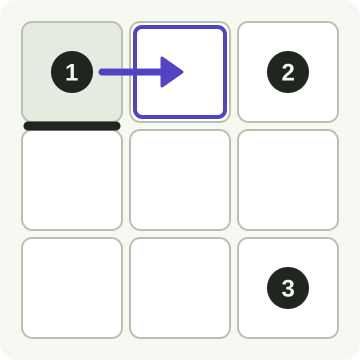
Worked example
A wall leaves one possible first step
- The route starts at checkpoint 1 in the top-left corner. The edge of the board blocks two directions, and a wall blocks the step down.
- The only way out is to the right. Keep checking walls and the checkpoint order as the path grows.
A teaching board, not one of today’s puzzles.
Keep what’s left in one piece
Picture the cells you haven’t visited yet. Can the end of your path still reach all of them in one sweep? If a turn cuts off a pocket, it’s the wrong turn. Narrow corridors force an order too: go in the wrong way and the cells on one side may become unreachable.
Backtracking
When more than one step looks possible, only extend the path as far as you can justify. If you spot a trapped cell, back up to the turn that caused it and work out why. That reason will save you time on the next board. A hint can show the next segment of the solution or a segment to remove.
For worked examples of these traps, read how to avoid dead ends.