

Rectangles splits the board into rectangles. Each one contains exactly one clue, and the clue tells you its size, its shape or both.
Reading the clues
A number is the rectangle’s area in cells. A shape clue says whether it’s a square, taller than it is wide, or wider than it is tall. A round clue means any shape will do. Some clues give an area and a shape together. Whatever the clue, its rectangle has to contain it and no other clue.
List the possible sizes
An area of 6 could be 1×6, 2×3, 3×2 or 6×1. On a narrow board, the long strips won’t fit. A shape clue cuts the list further: a wide clue rules out anything tall.
Then slide each remaining size around its clue. Throw out positions that run off the board, swallow another clue or overlap a rectangle you’ve already placed. If a clue is left with one size in one position, draw it.
Worked example
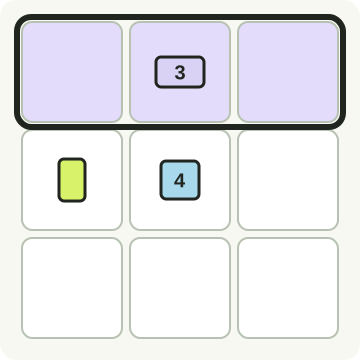
Area and shape fix the top piece
- The top clue asks for a wide rectangle with an area of 3. The only shape that fits is three cells across and one cell tall.
- The board is exactly three cells wide, so the piece is the whole top row, and the two clues below stay outside it.
A teaching board, not one of today’s puzzles.
Think about the empty cells
A finished board has no gaps, so every cell belongs to some rectangle. Take a corner cell and ask which clues could possibly reach it. If only one rectangle can cover it, that rectangle is forced, even if its clue looked wide open on its own.
Drawing rectangles
Choose two opposite corners to place a rectangle. Check that it matches its clue, holds only that clue and doesn’t overlap anything. When you’re done, every cell is covered exactly once. A hint can outline a rectangle to place or one to reconsider.