

Ribbons gives you pairs of matching endpoints. Join each pair with a ribbon, and fill every cell on the board while you’re at it.
What a finished board looks like
Each pair is joined by one unbroken ribbon. Ribbons travel up, down, left and right, never diagonally. They can’t cross, overlap, pass through the same cell twice or run through another pair’s endpoint. Every cell on the board, endpoints included, belongs to exactly one ribbon. Joining all the pairs isn’t enough if cells are left empty.
Start where there’s no room
Only one ribbon leaves an endpoint, so if an endpoint has a single free neighbour, that’s where its ribbon goes. Ordinary cells are stricter: a ribbon has to come in one side and leave by another, so a cell with only two free neighbours must use both. Corners and one-cell-wide corridors are the best places to find these.
Before you draw a long ribbon, look at what it leaves behind. A ribbon that reaches its partner can still be wrong if it walls off an empty cell or cuts another pair off from its partner. Each time, ask two questions: can every unfinished pair still meet, and can every empty cell still be filled?
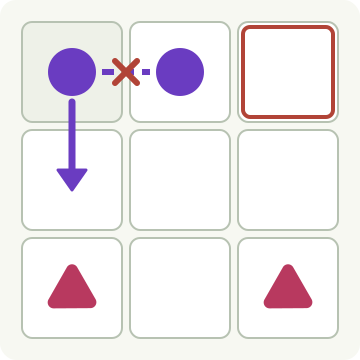
Worked example
A short connection can leave a corner unreachable
- The two top endpoints sit side by side and look ready to join. But that short ribbon would leave the top-right corner with only one way in, and no ribbon could pass through it.
- So the ribbon from the top-left endpoint heads down instead. A ribbon has to leave room for every cell, not just reach its partner.
A teaching board, not one of today’s puzzles.
Work from both ends
You can draw from either endpoint, and the cramped end is usually the easier place to begin. When a ribbon has a few plausible turns, extend it one step at a time. If a turn would trap an empty corner, rule it out and take the other one. If you can say why a turn fails, you’re solving. If you can’t, you’re guessing.
Redrawing is normal
You can back up an unfinished ribbon as you draw. If a finished ribbon is blocking the rest of the board, clear it and draw that pair again. The obvious short connection often has to bend out of the way to make room for everything else. When the next constraint is hard to spot, a hint can point to a segment to extend or one to rethink.